
Shipping Estimate
USA
- USA
- CAN
- USA
- CAN
Ships within 48 hours · Estimated delivery Jul 5 - Jul 10
 Promo Codes Available:
For Your Every Summer RSVP, with Code: SUMMER15
Description
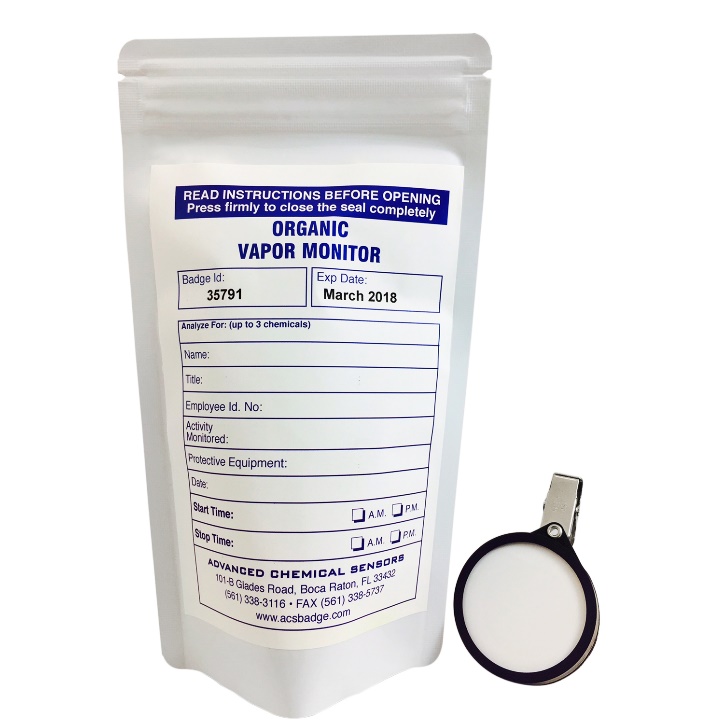
Fume Monitor BadgeThe fume monitor can be worn as a badge near the breathing zone to measure personal exposure, or placed in a room to measure area concentration. Workplace Exposure Monitoring Measurement of personal exposure is very easy. Clip the monitoring badge near the breathing zone of the worker. Record the start time and the stop time of the test on the pouch of the badge and return it to the laboratory for analysis in the mailer provided. The analysis report
The fume monitor can be worn as a badge near the breathing zone to measure personal exposure, or placed in a room to measure area concentration.
Workplace Exposure Monitoring
Measurement of personal exposure is very easy. Clip the monitoring badge near the breathing zone of the worker. Record the start time and the stop time of the test on the pouch of the badge and return it to the laboratory for analysis in the mailer provided. The analysis report will show the average concentration of the worker’s personal exposure level.
According to OSHA regulations, each person who uses a toxic gas as a regular part of their job must have their exposure monitored periodically.
Indoor Air Monitoring
Leave the badge in the area at least 5 ft off the floor for 24 hours. No need to hire expensive consultants. Record the start and stop times and send the badge back to the laboratory for analysis in the mailer provided. The analysis report explains if the concentration level of your home is exceeding the exposure limit.
Principle of Operation
Air diffuses through a micro-porous membrane and collects vapor on specially prepared adsorbents inside the monitoring badge.
How it Works
Our monitors are available in the form of “badges” that are worn by the employee during a sampling period. There’s no liquid or metal mechanics involved in our badge sampling, so the process is not cumbersome at all.
As for how the badge works, there is a microporous membrane that chemical vapors pass through. Under the membrane are special adsorbents that collect the vapors at a fixed rate. Our badges meet and exceed OSHA requirements, and OSHA/NIOSH validated methods are used in ACS’s AIHA-LAP, LLC-accredited laboratory.
Our badges:
- Cost less.
- Don’t need training.
- Don’t interfere with a worker’s activities.
- Test indoor air and personal exposure to toxic chemicals.
Here’s how personal exposure in the workplace is tested using our monitoring badges:
Step 1: Expose the badge
Workers clip the badge in or near a breathing zone, most likely on their person, to measure their personal exposure level to certain chemicals. Badges can be placed in rooms to measure the concentration of chemicals in the air. When clipped on a person, the badge is small and lightweight enough to not interfere with worker activities.
Step 2: Record Start Time and Stop Time
Record the requested information on the outside of the pouch that will enclose the badge after testing is complete. The required information includes the start time and stop time of testing.
Step 3: Return the Badge for Analysis
- Fast Turnaround Time
- Reliable Results
- Tested in an AIHA-LLP, LLC Accredited Laboratory
- The Lab is NY ELAP Accredited
When the test is finished, put the badge back into the pouch, make sure the ziplock is completely sealed, and mail it back to our lab for analysis. Our normal turnaround time is 72 hours after samples have been received. Some chemical analysis may take longer than 72 hours. Reports can be emailed, faxed, or mailed.
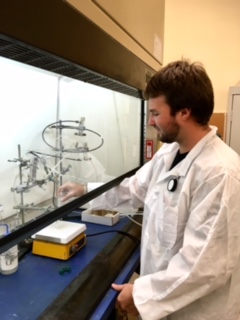
Workers can clip the badge near the breathing zone to measure person exposure level or place it in a room to measure area concentration. Badges are small and lightweight and do not obstruct the worker activities.
For Testing Indoor Air Quality or Area Monitoring
Simply leave the badge in the area for 24 hours.
To test indoor air quality of your lab, leave the badge in the area at least 5 ft off the floor for 24 hours. No need to hire expensive consultants.
|
OSHA |
NIOSH | ACGIH | |
|---|---|---|---|
| TWA (ppm) | 0.75 | 0.016 | |
| STEL/CEIL (ppm) | 2 | C 0.1 (15 min) | C 0.3 |
| AKA | |
|---|---|
| CAS# | 50-00-0 |
| Analytical Method | NIOSH 2016 |
| Absorbent | Silica coated with DNPH |
| Minimum Level of Quantitation | 0.01 PPM for 8 Hours 0.3 PPM for 15 Minutes 0.002 PPM for 24 Hours |
| Recommended Sampling Time | Workplace: 15 minutes to 8 hours Indoor Air: 24 hours – 48 hours |
| Interferences | No interferences are known |
| Effect of Temperature | Less than 10% for each 10°C variation from 24°C |
| Effect of Humidity | No effects detected at 30% RH to 92% RH. |
| Accuracy | Meets or exceeds OSHA accuracy requirements of +/- 25% |
| Storage Conditions | Store at room temperature. |
| Recommended Holding Time | Monitors need to be returned to Lab within two weeks after sampling. |
Shipping Notes
- Free Standard Shipping on $100+ Orders to the USA.
- Except Preorder products are shipped in 48 hours.
- Delivery to the USA:
- Standard Shipping : 3-10 business days
- If time is of the essence, please consider selecting expedited delivery for faster service.
Exchange/Return Notes
- We offer a 30-day return/exchange service after receiving.
- Final sale items are not eligible for returns or exchanges.
- To process your return/exchange, please contact us at [email protected]
- Please click here for more details>>> Return & Exchange Policy