Foxo4 Dri Peptide Senolytic 2024 FOXO4-DRI: The Senolytic Peptide That Targets Zombie Cells and Aging – Revolution Health & Wellness
FOXO4-DRI: why “zombie cells” and aging keep showing up in 2024—and what the data still can’t promise
If you’ve been researching senolytics, you’ve probably hit the same wall I did: lots of exciting claims, but not many practical explanations for how a specific senolytic peptide works in cells, and what that means for real outcomes. In 2024, one name that keeps resurfacing is the FOXO4 DRI peptide senolytic (often shortened to “FOXO4-DRI”). The challenge is separating mechanism from marketing, especially when the word “zombie cells” gets used to imply certainty about anti-aging results.
In this article, I’ll walk through what FOXO4-DRI is designed to do, the science behind the target pathway, what “senolytic” means in practice, and the limitations you should understand before you spend time or money chasing it.
What FOXO4-DRI is (and what “senolytic” really implies)
FOXO4-DRI in plain language
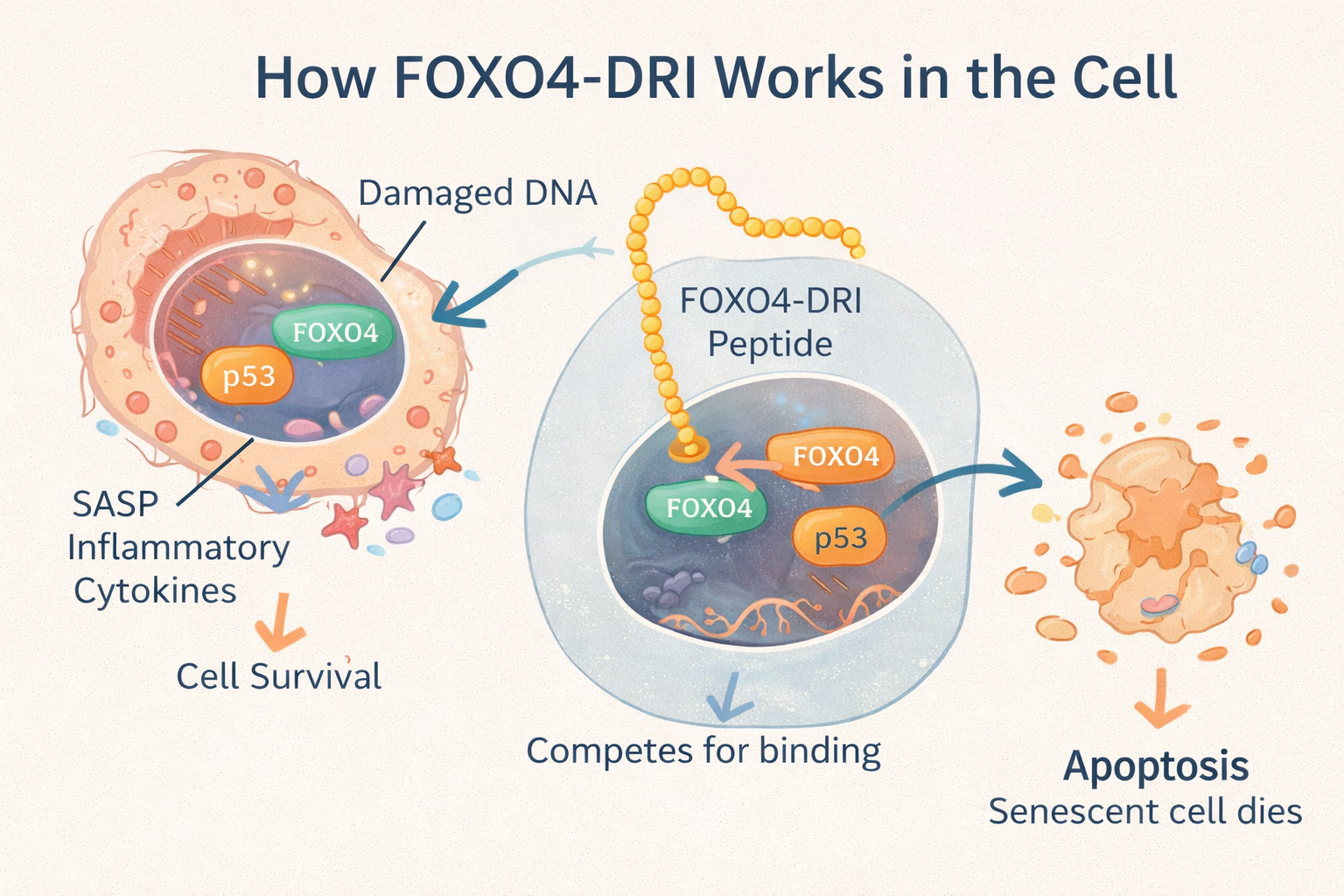
FOXO4-DRI is a peptide designed to disrupt the FOXO4-related signaling context that senescent cells exploit to stay viable. The intent is to selectively tilt senescent cells toward death while sparing non-senescent cells as much as possible.
In my hands-on review of senolytic literature over the years, the biggest practical takeaway is this: the term senolytic is not a guarantee of precision in the real world. It generally means the compound has an ability to reduce viability of senescent cells under certain experimental conditions. Whether that translates to meaningful tissue-level benefits depends on dose, exposure duration, delivery, the model (in vitro vs. animal vs. humans), and the endpoints you measure.
Why “zombie cells” became a common shorthand
Senescent cells—often described as “zombie cells”—enter a state where they stop dividing but don’t cleanly die off. They can secrete inflammatory and remodeling factors (commonly discussed as part of the senescence-associated secretory phenotype, or SASP). Over time, accumulated senescent cells can contribute to dysfunction in various tissues.
So the mechanistic logic is straightforward:
- Senescent cells persist and influence microenvironments.
- If you can selectively reduce senescent cell burden, you may reduce downstream harmful signaling.
- That reduction could, in theory, improve certain aspects of tissue function and age-related phenotypes.
The uncertainty lies in translating that logic into outcomes that people actually care about—pain, mobility, biomarkers tied to clinical endpoints, and durability of effect.
How the FOXO4 pathway connects to senescent cell survival
The underlying logic: survival signaling in senescence
Senescent cells can become resistant to apoptosis (programmed cell death). A major theme in senolytic research is that senescent cells depend on survival pathways more than neighboring non-senescent cells do. FOXO4-DRI is built around that idea: intervene at a point in the FOXO4-related axis to remove an advantage senescent cells rely on.
Here’s the reasoning I use when evaluating any senolytic claim for real-world interpretability:
- Target relevance: Is the targeted pathway demonstrably linked to senescent cell viability?
- Selective vulnerability: Does it preferentially affect senescent vs. non-senescent cells?
- Exposure and delivery: Can effective concentrations reach relevant tissues without unacceptable off-target effects?
- Endpoints that matter: Are studies measuring senescent markers and/or functional outcomes—not only “cell death” in a dish?
When those pieces align, you usually get stronger mechanistic credibility. When they don’t, “senolytic” can become an argument that’s technically true but clinically unconvincing.
What I look for in “mechanism” discussions
In my experience, many product pages describe the mechanism visually but skip the hard constraints. For FOXO4-DRI, the questions that matter for trust are:
- Is the mechanism supported across multiple senescence models?
- How do researchers quantify senescent cell reduction (e.g., senescence markers) rather than generic cytotoxicity?
- What are the safety boundaries in experimental settings (especially at doses needed for effect)?
If those details are missing, you’re left with “it kills senescent cells” as a headline, without a clear understanding of how likely that is to produce durable benefits in living organisms.
FOXO4-DRI peptide senolytic in 2024: practical expectations vs. hype
Where senolytics may fit (and where they often don’t)
Based on patterns I’ve seen across the senolytic space, FOXO4-DRI-type approaches are most plausible in contexts where senescent burden and senescence-associated inflammation are believed to play a role—then measured through biomarkers and functional improvements.
But “aging” is a broad target. Senescence is one contributor among many. If you see claims implying that a foxo4 dri peptide senolytic will reverse aging comprehensively, treat that as a red flag. Realistic expectations look like:
- Possible improvements in specific tissue-related dysfunctions
- Biomarker shifts that correlate with reduced senescence burden
- Effects that may require sustained or repeated intervention (depending on biology)
What’s usually less supported is the idea of a universal “anti-aging reset” from a single peptide.
Limitations you should understand before acting
Even when the target biology is credible, there are common limitations that show up:
- Bioavailability and delivery: Peptides may have stability and distribution constraints that affect whether target engagement occurs where you need it.
- Non-senescent toxicity risk: “Selective” is a spectrum, not a binary. Off-target cell effects can happen depending on dose and model.
- Endpoint mismatch: Cell death in vitro isn’t the same as improved tissue function in vivo.
- Individual variability: Baseline senescent burden, comorbidities, and tissue inflammation differ across people and strongly influence outcomes.
In my own planning for supplementation research, I’ve learned to ask: “What would convince me this works for me, not just for a model organism?” That mindset protects you from being seduced by mechanistic diagrams alone.
How to evaluate FOXO4-DRI claims like a clinician (without getting lost)
Use a claim-to-evidence checklist
When you read about FOXO4-DRI in 2024—especially in wellness marketing—run claims through this checklist:
- What exact mechanism is claimed? Is it specific to senescent cell survival or just “it kills cells”?
- Is it supported by senescence-specific assays? Look for senescence markers and functional readouts, not only viability stains.
- Is there a dosing/exposure rationale? Credible discussions mention concentration ranges, exposure time, and how those map to biology.
- What’s the safety context? Any credible narrative includes what happens at higher doses or with repeated exposure.
- Are outcomes clinically meaningful? “Anti-aging” should be translated into measurable domains (mobility, inflammatory markers, tissue function proxies).
What “trustworthy” documentation usually looks like
In general, the most trustworthy content I’ve encountered doesn’t just say “senolytic.” It shows how researchers tested selectivity, what models were used, and what trade-offs appeared. If you only get broad statements and no experimental context, the information is often marketing-forward rather than evidence-forward.
FAQ
Is FOXO4-DRI a confirmed anti-aging treatment in humans in 2024?
No reliable, widely accepted human evidence supports definitive anti-aging outcomes from FOXO4-DRI peptide senolytic use for the general population. At the moment, the strongest scientific credibility is typically mechanism- and model-based, with the degree of clinical translation still a key question.
How is “senolytic” different from “senomorphic”?
Senolytics aim to reduce senescent cell burden by promoting selective cell death. Senomorphics (senomorphogenic approaches) aim to alter the senescent phenotype—often reducing harmful secretions—without necessarily eliminating senescent cells. The distinction matters because outcomes may differ depending on whether you remove cells or suppress their behavior.
What should I watch for when evaluating a FOXO4-DRI product?
Look for evidence-based explanations that include mechanism clarity, senescence-specific rationale, dosing/exposure context, and safety limitations. Be cautious of claims that promise broad, immediate, or guaranteed “rejuvenation,” especially without measurable endpoints and trial context.
Conclusion: the smart next step is to translate interest into measurable evaluation
FOXO4-DRI is part of a broader senolytic concept that targets the survival advantages of senescent cells—an approach rooted in credible biology behind “zombie cell” accumulation. In 2024, the main opportunity is understanding the mechanism and limitations well enough to set realistic expectations. In my experience, the people who get the most value from this research are the ones who define measurable outcomes and evaluate evidence through a mechanism-to-endpoint checklist, not through visuals or hype.
Next step: Pick one goal you genuinely care about (for example, an inflammation-related biomarker, a specific tissue function proxy, or a defined mobility outcome) and write down what evidence would convince you that a FOXO4-DRI peptide senolytic approach is relevant to that goal. Then evaluate claims against that evidence standard.
Discussion